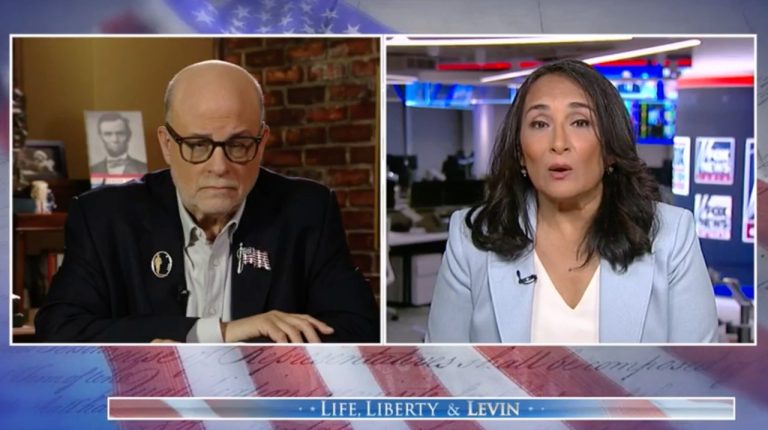
On Thursday’s Mark Levin Show, what made the Declaration of Independence remarkable was that it was unprecedented in human history. The Declaration serves as the foundational basis for the nation and its Constitution, celebrating America’s purpose. Critics like Presidents Obama and Woodrow Wilson have rejected or downplayed its first part on the Creator and principles, focusing instead on the list of grievances against the king to advance new ideologies; however, President Coolidge defended these enduring, universal ideas from Aristotle and Locke as perpetual, not to be dismissed. The Declaration’s concise statement of American identity is incompatible with Marxism, Islamism, and fascism. Also, President Reagan was a great admirer and friend of Milton Friedman. He often sought his input on economic policies. During Reagan’s presidency, there was massive economic growth, and he won two historic landslide elections, popular vote and electoral college, like no Republican before or since. Alexander Hamilton would grow increasingly supportive of a powerful central government. He would argue with Thomas Jefferson and James Madison on their approaches to government during the Washington administration and beyond. Hamilton argued for implied powers under the Constitution, which infuriated Jefferson and Madison. Hamilton claimed the necessary and proper clause was essentially a ticket to significantly expanding federal action. Later, Americanism and capitalism are philosophies enabling individual decision-making under the Declaration and Constitution, whereas ideologies are fanatical beliefs imposed society-wide regardless of consequences. Communism is defective and anti-human, misreading human nature by suppressing free will, reason, debate, and academic freedom in favor of brainwashing, conformity, and central control, as seen in places like Cuba, Nicaragua, North Korea, and China, and similarly with Islamists. Nationalists, populists, and Marxists attack the American experiment, economic system, and culture through emotion, slogans of equality, and activist government, showing overlaps reminiscent of 1930s fascists and communists.
Breitbart
Schweizer: More than a Million ‘U.S. Citizens’ Being Raised in China Due to Birth Tourism
CNN
Bloodier than Stalingrad: Number of casualties in Russia’s war on Ukraine reaches 2 million
USA Today
Fellow players buried Caitlin Clark on WNBA All-Star Game ballots
X
SHOCKING VIDEO: What does a neo-Nazi have in common with a DSA politician?
X
Three minutes of Tucker Carlson praising Islam.
Photo by Bettmann
The podcast for this show can be streamed or downloaded from the Audio Podcast page.
Rough transcription of Hour 1
Segment 1
Hello, America. Mark Levin here. Our number 87738138118773813811. What is it that we celebrate and acknowledge on July 4th, 250 years ago? Oh, well, we had delegates sent from the colonies to the Second Continental Congress in Philadelphia on July 4th. They issued a declaration. A declaration stating why they were prepared to go to war for their independence from the British Empire, the most powerful military force on the planet. The men who would sign this document were signing a death warrant. The British were actually very. Brutal. Very brutal. And if they caught any of them, they would have hang them. It also meant their families were on the line, their farms and businesses were on the line. Very, very brave men and women. Men, I should say. And even so, only about 40% of the population supported them. About 30% did not and about 30% were neutral. But what was it about July 4th that was so special? The Declaration of Independence. Okay, big deal. Right now, the big deal is this Never before. Never before had a document contained the kind of philosophy. About individualism, about humanity. A representative government. Never before. In all of human history. As a country, people willing to go to war over these beliefs and these beliefs came from the Judeo-Christian values and principles. They came from the Enlightenment. We know this just by reading it. We also know because. The main author of the first draft of the Declaration said so. Thomas Jefferson. These men don’t agree on all matters. Some are agrarian, some are more. City like and and so forth. But they agreed on the principles. On the principles. What makes this especially remarkable and rare? They’re prepared to go to war. Not for power. They were prepared to go to war. For liberty and not just their own liberty. But for the liberty of all inhabitants of America. What did they say? They weren’t bashful about what they believed. They talked about. Unalienable rights. What does that mean? But these are. Rates that are not. Subject to government, not subject. To being removed or destroyed. Because their God given unalienable rights. As a matter of birth. This was a new idea. This was a grand idea. It’s an idea that came from John Locke, among others. And what else? What else was it? About this Declaration of Independence. It was an acknowledgement that the civil society. Pre-existed before any government. The civil society with this social contract. Where individual citizens freely come together. To form a society. To protect each other. To do commerce with each other. We’d never seen anything like this before. Ever. They talked about natural rights and natural law and the world over that. Natural rights and natural law. This underscores their point. That the rights you have don’t come from a man. They come from nature. They come from God. Natural laws. The law. The civil society. Again predates any government. They talked about these truisms. These essential truths. What’s an essential truth? It’s something that’s true no matter where you live, no matter who you are. For instance, the golden rule do to others as you would have them do unto you. That’s not limited to national boundaries or any government. What about the Ten Commandments? Starting with Thou shalt not murder. That’s a universal truth, is it not? So they come together. Truth be told, the Revolutionary War had already actually begun. In Boston. In New York. In other parts of. Of the colonies. And they came together. From South Carolina and Georgia. Massachusetts. And New York and Pennsylvania and. Virginia. They came together. And in a very short order, they wrote this. They agreed to this Declaration of Independence. There were five drafts in all. Five drafts in all. We’re celebrating on July 4th, not just a document. We’re celebrating the reason, the purpose for this country. The Constitution is a governing document. It’s the most magnificent governing document ever drafted by human beings. But the declaration serves. It’s the principle basis for everything. It’s concise. And yet it’s expansive in its application. The declaration is rejected. I. Barack Obama, used to leave out the part about the creator. As mentioned several times in the document. It is rejected by man. Who’s going to do a grave? Damaged. To our celebration because he plans to give a speech. I went back when I wrote one of my books, ladies and gentlemen. And I looked at the speech that Woodrow Wilson gave on July 4th, 1914. Woodrow Wilson was an early American Marxist. He’d been a professor. He’d been president of Princeton. As a radical ideologue. Progeny of Marx. That’s why I wrote American Marxism. So you would understand all that. And he gave a speech on the. On the steps outside of Independence Hall in Philadelphia on that July 4th. Essentially eviscerating the document. Don’t pay attention to the first part of the declaration, he essentially said. Pay attention to the second half of the document. You see the first half of the document? Lays out the purpose for the revolution and the purpose for the nation. The second half has a list of grievances against the king. Woodrow Wilson said, Look. Back then in 1776. These colonists, these Americans. They had their own issues. They espoused them. And. The key is that they raised all these these concerns with the king. And he said, Look. We’re new. 1914. We have our own issues. We have our own problems. Our own. Our own society. We have a right, just as they did. To assert what we believe the country’s about. We’re not required to parrot and mimic what they said in 1776 on July 4th. And he says it again in front of independents on 1914. And so they go to the list of grievances. And I suspect Madame in the others. What, because they don’t believe in the first part of the declaration. If you’re a Marxist in an Islamist, you can’t. Because your ideology. It’s not about. It’s not about the founding of America. It’s not about. The declaration and the principles that undergird. But you’re more than happy to. Regurgitate the list of the problems that they presented to the king, because that’s what it’s all about. Is he not these fundamental principles? No. No fundamental beliefs and values? No, we’re rejecting those. It’s about all the problems you want to raise with society and government. That’s the focus. Not long thereafter, another president. Coolidge. A great, great president. He gave a speech. Almost at the exact same spot as Woodrow Wilson. In front of Independence Hall. About the Declaration of Independence. And he basically condemned Wilson and condemned, Wilson said. A court said. These are not old ideas. These are not ideas just for one generation of Americans. These are universal. These are. Ideas that should exist in perpetuity. They go back to Aristotle. They go back to lock. They’re not to be dismissed for some kind of a new ideology. This is our founding belief system, the Declaration of Independ. So Coolidge basically used the opportunity to straighten out Wilson. When Barack Obama spoke, he did the same thing Wilson did. Because, you know, they all their little cheat sheets. They see what the prior marks have said. The Declaration of Independence is the most concise. Substantive. Ingenious statement of who we are as a people. The problem. For the Marxists. For the Islamists. For the fascists. Is that in order to embrace the Declaration of Independence, you must condemn them. This is why I’ve written in two books and I’ve stated here over and over again and others have regurgitated what I’ve said long time ago. That these ideologies that came out of Marx, they came out of the American Marxist that came out of these Islamists are utterly incompatible with Americanism. That’s why their candidates now openly trash our country. And seek to destroy it more when I return.
Segment 2
A majority of Democrats say they would vote for a Democratic socialist, and they view socialism favorably. If we don’t if we don’t do something about these colleges and universities. We’re never going to recover from this. Also, we’re importing people who believe these foreign ideologies. And this is what the Democrat Party wants. Once again, the last book I wrote is called On Power. They’re about power, not about the Declaration, the Constitution, capitalism. Just keep something in mind. You and I don’t believe in a powerful central government. That’s why I reject some of the things JD says and some of these others say. These so-called nationalist populists. No, no. There are guardrails in our system. Guardrails. And those guardrails are crucial for whomever wants to do whatever. And the point is this. If you’re a communist, an economic socialist and an Islamist, you don’t want these guardrails. You want power. You want it centralized. And yet you camouflage it with all kinds of talk about democracy. Pursue this more when we return.
Segment 3
Ladies and gentlemen, there are a lot of hucksters out there, Podcasters among others. They go on and on about, you know, if your favorite tax cuts and you do this, you know, you basically if you adopt the Reagan agenda, you’re going to get creamed. You’re going to lose. There are others like the Veep who says, you know, basically the days of Milton Friedman are over. He’s more a Hamiltonian Now, to a lot of people, they don’t know what he’s talking about because they’re not familiar with those men in terms of policy. Let me explain something. One of the great admirers of Milton Friedman was Ronald Reagan. And Reagan sought to adhere as much as he could, as much as any president can to many of the ideas and beliefs of Milton Friedman. Milton Friedman was a laissez faire economist, and Reagan’s position was that’s the basis from where we start. I also want to remind you that school choice was Milton Friedman’s invention. That was his idea. I spoke to many decades ago about it, and Landmark Legal Foundation litigated on behalf of school choice. It was his idea in the 1950s. He had great ideas across the board for many of the entitlement programs and so forth. I will also remind you that the economy during Reagan’s eight years. Had massive growth. Massive expansion. The economy in the United States grew 25% during the Reagan years. We’ve never seen anything like it before. Never. It was massive. And I’ll remind you also that Reagan won two of the biggest landslides in Republican electoral history. His election and his re-election, the popular vote and the Electoral College vote. And the second time around, he won every single state except Minnesota. What you lost by 3000 votes to Mondale, who was running against. So just a flip of 1500 votes. He would have won every single state. I want you to think about that. So when you have people downplaying Milton Friedman or downplaying Ronald Reagan, I don’t really think they know what the hell they’re talking about. They’re embracing these Pat Buchanan ideologies and big government ideologies and a centralized government ideologies. Now, Alexander Hamilton was a great man, and you’ll hear about Alexander Hamilton and how he how he created basically the financial. Basis for the national government, which needed a lot of help after the Articles of Confederation and after the Revolutionary War. But Hamilton wasn’t just about that. His arch enemies were James Madison and Thomas Jefferson. Now, why would that be? Because Hamilton took a very, very liberal view of the Constitution. When it came to the First National Bank during Washington’s administration. Washington asked as secretary of the Treasury, Hamilton what he thought about it. He asked his secretary of State, Jefferson, what he thought about it. He asked Madison what he thought about it. Hamilton was all in. Jefferson and Madison said, wait a minute, there’s no constitutional authority for a national central bank, a government run bank. The states can have all the banks they want. The private sector can have all the banks they want. Washington sided with Hamilton. Madison, the father of the Constitution, says, Where does this authority come from? Hamilton said. The implied powers of the Constitution, implied powers, Jefferson said. There are no implied powers. An implied power means you can do whatever you want. There’s the text of the Constitution, the meaning of the words, the context of the adoption of the Constitution. But there’s no implied powers. We fought like hell in Philadelphia for five months. It’s nothing about implied powers. After the Washington administration, the National Bank was eliminated, but it came up again. They came up again and the presidency of Andrew Jackson. Who opposed a national bank. Who opposed it. What I’m getting at here is this. There’s a reason why Alexander Hamilton is considered the greatest of the founding fathers by the left. There’s a reason why there’s a play. Called Hamilton and not a play called Madison. And not a play called George Mason and so forth. Now, it’s very interesting as I write in my book on power. You may recall, Hamilton. In Madison and John Jay, to a lesser extent, he’d be the first chief justice. But nonetheless, you might be surprised because they advocated strongly for the Constitution and a limiting power because the states were not going to ratify the Constitution if they heard about these implied powers, among other things. But then Hamilton moved. And so if we ever do get J.D. here, I would like to have this discussion. Because, ladies and gentlemen, here’s a deal. You know the Marxists. Believe the world begins today. American history doesn’t matter. Declaration. Constitution. They don’t really matter. Just like Woodrow Wilson said, We’ve got problems today, we’ve got issues today, and we get to decide how we’re going to resolve this without the limitations placed on us 200 some years ago. We have our own society, our own representatives. And so they seek to cut us from the moorings of the nation. So it’d be just another failed country doing stupid things. But that’s not why we’re great. We’re not great because government bureaucrats and politicians have great ideas. We’re great because their power is limited, because you have great ideas, maybe have stupid ideas, but the ideas you’ll do as you wish. Other people will do as they wish. But the Marxists, the American Marxists, they believe the world begins today because that’s what Marx tells them. All this past history. It’s poison. All it does is drag us down, poisons our thought processes. The world begins today. We take in new information. And we apply it. Unbound from. Historical perspectives are acts. Because they hold us back as human beings. We need a completely clean slate. You know, Edmund Burke talked about the importance of experience, one generation to the next, to the next, teaching each generation along the way, learning from each generation along the way. Mark says that’s bogus. That’s bogus. Keep in mind, he also says religion needs to go. The nuclear family need to go. Why? Because we have great new ideas. We can’t be. We can’t be anchored down. By these old ideas and these old associations. And these old social arrangements. Religion, he said, is mysticism. The family structure exists for the family, not for the greater good of society. 80. This is who this so-called Democratic socialist movement is all about. And so I would encourage us to explain to some of our brothers and sisters who are Republicans and otherwise you’re dabbling. In a toxic water. When you say, Oh, yeah, well, we want to use government for the interests of the people. Of course, government is supposed to be for the interests of the people, but in the context of its limitations, you know, it’s not like there isn’t government activity. We have localities, we have counties, we have states, we have the federal government. They’ve got bureaucrats all over the place. But government’s got to get a deliver for the people. Deliver what? And where is the line between the nationalist populists? And the socialists. Where’s the line? There is no line. It’s knee jerk or shoot from the hip. The greatest period of growth we’ve had in this country in modern times. Whatever anybody says is up to them. And you can look it up was the eight years of the Reagan administration. It was massive. It touched every corner of our country. Every corner of our society. We’d never seen anything like it before. Because his tax cuts were massive. They were across the board. They were for big corporations, little companies, individuals. The inheritance tax, so-called, went down to zero. Zero. Capital investment. When Reagan got in, you could deduct it over a period of even decades. He eliminated that. You could deducted over a period of one year, maybe two. Freedom. It’s called freedom. And it actually works. And I just fear they’re going into battle with the communists and the Islamists and these phony democratic socialists. We don’t know our own history. We don’t know how to make the case for our own country. And too many of our people look starry eyed, dumbfounded. In the face of affordability fairness. Billionaires. They don’t know how to respond. And so they embrace ten, 20, 30, 40% of it. Rather than push back. I’ll be right back.
Segment 4
I just decided today was a good day to get into some of these things given July 4th is upon us. This is July 2nd. We will not be here tomorrow. So this is the last time I’m talking to you before July 4th. And this is a very exciting period to me. 250 years. But it’s also a very grave situation that we’re in right now. Some people blow this off. They say you’re overreacting and say, no, you’re not. We’re facing threats and enemies. We’ve never faced like this before, certainly not in an organized fashion. The Democrat Party is led by we as also quislings and weaklings. And so that party is doomed. And you listen to these candidates, some of them are 29 years old. They’re failed lawyers. They’ve accomplished nothing. AOC accomplished nothing. You got this guy in Maine who accomplished nothing. He’s a horrid human being. Got this guy in New Jersey, literally was working with a blind sheik. Stunning, shocking. You’ve got individuals who support Hamas and other terror groups running for office and winning the Democrat primaries. Now, there’s not a lot we Republicans can do about Democrat primaries. But we have to make sure when it comes to the general elections, we do everything humanly possible to stop these people. But we will lose our country. They’ve tried everything. Open borders. That’s why this birthright citizenship decision. Listen. Ignore the buffoons, some of whom claim to be conservative. That’s the big deal. We’ll pass legislation. It doesn’t work that way. This is a singularly disastrous decision. Disastrous because the court majority was cowardly. They knew what jurisdiction meant back then. We know what it means today. Nobody contemplated illegal aliens having children in this country Who would be citizens? Nobody. I don’t care if they write 100 pages or a thousand pages to try and make the case there is no case to be made. We’re up against these Islamists. We’re up against these communists. They don’t play by the rules. They use our system to destroy our system. I fear that apart from a handful of individuals. Uh, we don’t know how to fight back, and so we dismiss it. You know, country goes through cycles and phases. No. Excuse me. Don’t acquiesce to this. More when I return.